
When hail or straight line wind moves across the Tulsa metro, the commercial buildings in its path do not all fail the same way. A twenty year old modified bitumen roof over a retail center behaves nothing like a two year old TPO system on a distribution warehouse, and the damage on both is often invisible from the parking lot. That is why storm losses on commercial property get underpaid so often. Nobody documented what actually happened up there.
Decor Roofing and Restoration has handled commercial storm damage across the Tulsa metro since 1987, from our headquarters right here in Bixby. We are a full service commercial restoration contractor, which means the roof, the water that came through it, and the interior reconstruction all happen under one contract with one accountable project team. You are not coordinating a roofer, a water mitigation company, and a general contractor while your tenants are asking when they can reopen.
We are an IICRC Certified Firm, company number 70249741, with certified water damage and fire and smoke restoration technicians on staff. Our inspector is HAAG certified and documents in Xactimate, which is the format commercial adjusters work in every day. Call (918) 382-7663 any time.
Lorem ipsum dolor sit amet, consectetur adipiscing elit. Ut elit tellus, luctus nec ullamcorper mattis, pulvinar dapibus leo.
Commercial hail damage is not one thing. The membrane or panel on your building determines what the hail did, how quickly it will turn into a leak, and how it needs to be documented for a claim. This is the part most inspections get wrong, because a walk that treats every flat roof the same will miss the failure mode that matters.
Hail on a thermoplastic membrane fractures the reinforcing scrim inside the sheet without always breaking the surface. From above it can look like nothing more than a scuff. What has actually happened is that the layer carrying the membrane’s strength has been broken, and the sheet will split along that line under the next thermal cycle or foot traffic. Impact around penetrations and at seam welds is the most urgent, because those are the points already carrying stress.
EPDM bruises. The hailstone drives the membrane down against the substrate below and crushes it, leaving a circular mark that is often easier to feel than to see. Where the roof is fully adhered over a hard deck the bruising is worse, because the membrane has nowhere to give. Bruised EPDM frequently holds water out for another season and then fails suddenly, which is why a documented inspection right after the event matters more on rubber than on almost any other system.
On granule surfaced modified bitumen, hail knocks the granules loose and exposes the asphalt underneath to ultraviolet light. The roof does not leak that week. It ages several years in one season instead, because the layer protecting it from the sun is gone. On gravel surfaced built-up roofing the same thing happens with the ballast displaced, and the bare spots show as dark patches across the field. Heavier stones fracture the ply mat itself, which is a repair rather than a cosmetic matter.
Metal dents, and a dent by itself is often cosmetic. What is not cosmetic is a fractured protective coating at the impact point, because that is where corrosion starts, and hail striking the fastener heads on an exposed fastener roof, which breaks the seal on the washers. A metal roof that took hail two years ago and is now showing rust streaks below the fasteners is telling you exactly when the damage happened.

Wind damage on a commercial roof almost always starts at an edge. The field of the roof is the strongest part of the assembly. The perimeter, the corners, and anything that sticks up are where uplift pressure concentrates, and that is where a storm finds its way in.
After a tornado event, the question is structural before it is anything else. We do not put crews on a roof with suspected deck or joist damage until the structure has been assessed. Keep everyone out of the affected sections of the building and call us.
What happens in the first two days shapes the entire claim and most of the final cost. The scope only grows from here, so the goal is to stop the damage and record what it looked like before anything was disturbed.


Property managers who have handled a claim on their own home are often surprised by how different a commercial loss is. The differences are worth knowing before you are in one.
We document all covered damage in Xactimate, meet your adjuster on the roof, and coordinate through the claim. That work is included with any project we complete. We are a restoration contractor, not a public adjuster, so the settlement decision remains between you and your carrier. What we control is that nothing goes undocumented.
Oklahoma sits in the part of the country that produces the most concentrated hail and wind damage to commercial property in the United States. Around the Tulsa metro the heaviest activity runs from March into June, with a secondary autumn window, and it is normal for a single spring to bring several separate qualifying events.
That creates a practical problem for building owners. Damage from an April hailstorm frequently does not become a leak until July or later, and by then the reporting window on the policy may have closed and the loss date is difficult to establish. Insurers know this. It is one of the most common reasons a legitimate commercial claim gets denied.
The way around it is straightforward. After a significant hail or wind event in your area, have the roof inspected and documented even if nothing is leaking. A dated condition report costs you nothing and establishes exactly what happened and when. If the roof is fine, you have a clean baseline for next season.
Storm damage rarely stops at the roof. Once water is inside a commercial building, the loss involves the roof assembly, the interior, and often the tenant’s operations. We handle all of it.
Every project below is real, dated, and documented on site with photographs. This is the same assessment process we bring to a storm loss.
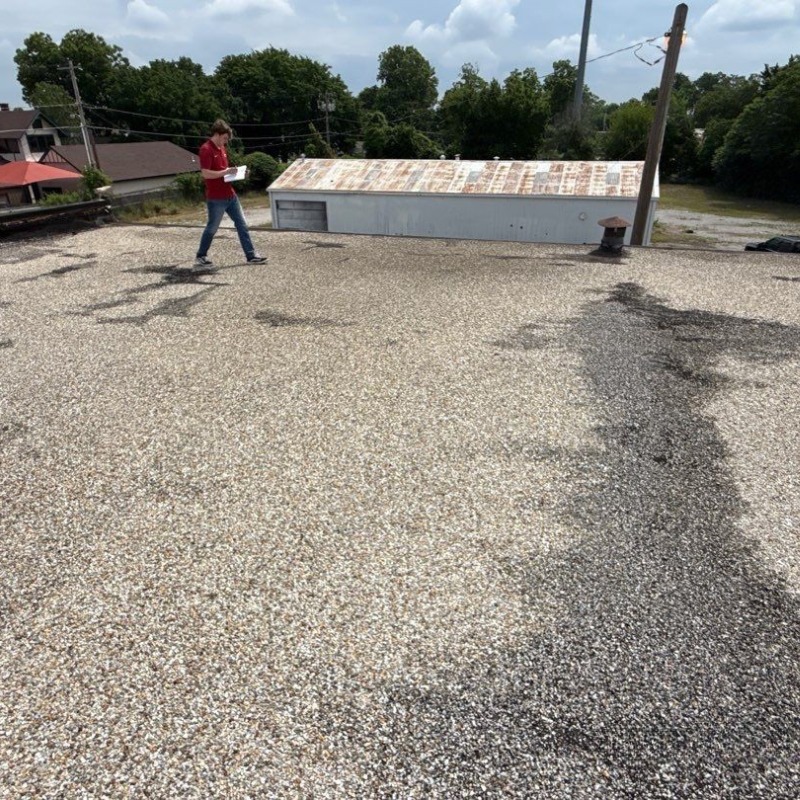
A mixed modified bitumen and TPO roof on a Bixby retail property, assessed section by section in May 2026. One section needed replacing. The other needed nothing but a maintenance plan, and we said so.
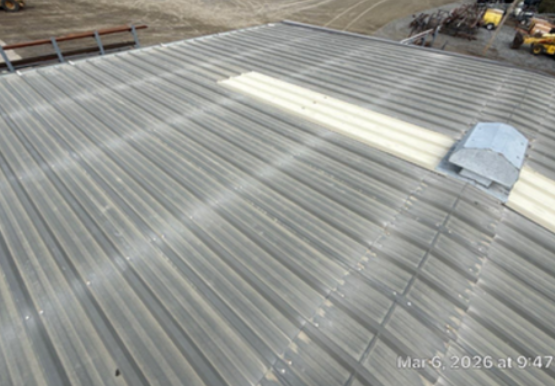
An aging exposed fastener metal roof on an industrial building, inspected in March 2026. We priced two honest paths forward, a coating restoration and a flute fill with 60 mil TPO, and the option carrying twice the warranty came in at the lower number.
If a storm has come through and you are not sure what it did to your roof, we will come look at it and tell you plainly. If there is damage, you get a documented report your carrier can work from. If there is not, you get that in writing too.
Within 30 days of the event. Most commercial policies have a reporting window measured in days, and hail damage to a commercial membrane frequently does not leak for months. By the time it does, the loss date is hard to establish and the claim window may have closed. A dated inspection right after the storm protects your claim whether or not you end up filing.
In most cases, yes. Hail, tornado and high wind are covered perils under virtually all commercial property policies. What varies is coverage for interior damage, business interruption, loss of rents and code upgrades, which depends on your specific policy and endorsements. We document all covered damage in Xactimate and coordinate with your adjuster throughout the claim.
Yes, and that is the most common scenario. Hail can fracture the reinforcing scrim inside a TPO or PVC membrane, bruise EPDM against the deck, or strip granules from modified bitumen without opening a hole. The roof keeps water out for another season or two and then fails. This is why damage is documented by system rather than by looking for active leaks.
In most cases, no. We develop a phased plan that sequences work by zone so unaffected areas of the building stay open. On multi tenant properties we coordinate directly with building management on scheduling, access and containment. Some structural damage does require closing a section, and if that applies we tell you at the assessment rather than mid project.
The IICRC is the certifying body for the cleaning, inspection and restoration industry. A Certified Firm registers with the IICRC, employs technicians who hold IICRC certifications, and pledges to maintain awareness of the published standards for restoration work. Decor is IICRC Certified Firm number 70249741 with certified water damage and fire and smoke restoration technicians on staff.